A solid balm or an oil-based roll-on is made through a short sequence that contains more decision points than it appears to. The scent has to be matched to a base, the base has to be tested with the fragrance and the container, the fill temperature and cooling have to be controlled, and the pack has to survive all of it. Walking the steps once, with the question each one answers, is the quickest way to see where a first order actually slows down.
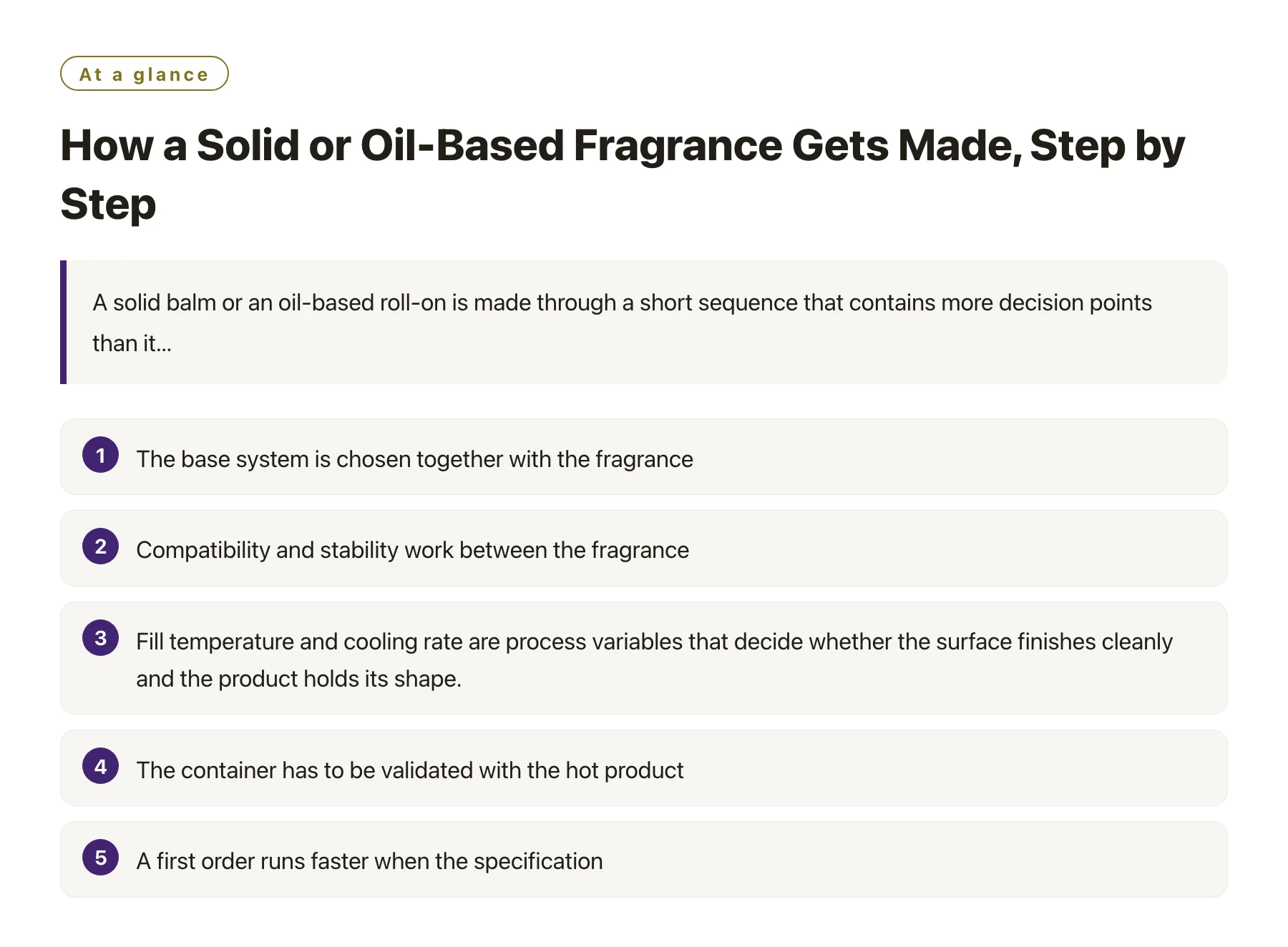
Key takeawaysThe base system is chosen together with the fragrance, not after it, because waxes and oils change how a scent reads and how strongly it develops. · Compatibility and stability work between the fragrance, the base and the container belongs early in the sequence, before the pack is confirmed. · Fill temperature and cooling rate are process variables that decide whether the surface finishes cleanly and the product holds its shape. · The container has to be validated with the hot product, because a tin or stick that behaves in a sample may behave differently at production temperature. · A first order runs faster when the specification, the container and the artwork are all frozen before the pilot batch rather than during it.
Production processes look linear in a diagram and behave circularly in practice, because any step can send the project back one place. A solid fragrance is a good example: the sequence is short, but the dependencies between the base, the fill and the container are tight, and an early assumption is expensive to undo.
This walkthrough is for a founder placing a first solid or oil-based order who wants to know what happens, in what order, and which question belongs at each stage.
The steps, in order
- Write the brief around the formatState the product type, the container, the target intensity and the market, because all four constrain the base before any scent direction is chosen.
- Select the base systemWaxes, oils and butters are chosen for melting point, skin feel and fragrance solubility, and this decision shapes the finished product more than most founders expect.
- Match the fragrance to the baseThe same concentrate can read differently in a wax or an oil, so the dosage is set against the base rather than against a blotter.
- Sample and evaluate on the intended surfaceJudge the samples on skin or on the surface the user will actually experience, at the temperature the product will be used at.
- Run compatibility and stability checksFragrance, base and container are tested together, including a period at elevated temperature, before the specification is locked.
- Freeze the specificationDosage, base formula, fill weight, container and tolerances are written down and signed by both sides.
- Run a pilot batchA small production-scale batch confirms fill temperature, cooling behaviour and surface finish before the main run begins.
- Fill, cool and inspectUnits are filled at the controlled temperature, cooled under defined conditions, and inspected for fill weight and surface defects.
- Pack, label and releaseSecondary packaging, labelling and the batch record complete the order, and a release signature closes it.
Three steps where first orders stall
Base selection, because it gets treated as packaging
Founders often arrive with a tin and a scent in mind and treat the base as a detail. It is not a detail. Melting point decides whether the product survives a warm car or a bathroom shelf, and the oil blend decides whether the fragrance blooms or sits flat. Changing the base late is effectively restarting the development.
Understanding the stages of perfume production helps here: decisions that constrain the formula come first, and cosmetic decisions follow. Moving the base decision later inverts that order and costs a sample round.
Compatibility checks, because they look optional
There is no useful short cut here. A fragrance that is stable in alcohol may interact with a wax base or with the lining of a tin, and the failure usually appears as discolouration, sweating or a texture change rather than as a smell problem. Finding it after the main run is the expensive version of the same discovery.
The interaction between a fragrance and its carrier is a standard formulation problem, and stability testing is ordinary practice in cosmetics rather than an optional extra [1]. Raw material behaviour, including melting points and solubility, is also documented in public technical databases that formulators consult when choosing a base [2].
It also helps to understand dilution levels in fine fragrance, because dosage in a solid or oil format works on different principles from an alcohol spray, and a number that performs well in one format rarely transfers unchanged to another.
Pilot batches, because they feel like delay
A pilot batch is where fill temperature and cooling behaviour get settled in practice rather than on paper. Skipping it to save a week usually costs more than a week, because the main run becomes the experiment and there is no second attempt at that quantity.
Ask in advance what the pilot will measure and what result would stop the run. A pilot with no pass criteria is simply a small production batch with a different name.
What each step should produce
| Step | Output | Who signs it off |
|---|---|---|
| Brief | A written statement of format, container, intensity and market | Brand |
| Base and fragrance match | A base system and dosage that behave together | Brand and factory |
| Samples | Applied references evaluated on the intended surface | Brand |
| Compatibility and stability | A record of how the product behaves over time and temperature | Factory, reviewed by the brand |
| Frozen specification | The document that production is measured against | Both sides |
| Pilot batch | Confirmed fill temperature, cooling conditions and surface finish | Factory, with brand approval to proceed |
The right-hand column matters more than it looks. A step with no named sign-off is a step that anyone can reopen later.
What to prepare before the first production run
Bring the container sample, the artwork status, the target market and the quantity. Visit the website to see which solid and oil-based formats and containers a prospective partner already runs, because that list is the shortest route to knowing whether your pack is a standard item or a new tool. If the container has not been selected, say so at the start rather than after the samples are approved, because the container affects the fill step and sometimes the base itself.
Decide who on the brand side is allowed to approve a deviation. Solid formats produce cosmetic variation — a faint surface bloom, a slightly different shade, a small spread in fill weight — and someone has to judge whether a given batch is acceptable without convening a meeting.
A partner that runs OEM and ODM fragrance manufacturing will normally have its own standard for those variations. Ask to see it, and decide whether you agree with it before the pilot rather than after the pallet arrives.
Keep a retained sample from the pilot and from the first production batch, stored under the same conditions. For a solid product, storage temperature affects appearance as much as it affects smell, and two tins side by side answer most later questions faster than any report.
Finally, check how the product travels. An oil-based or solid format often avoids the transport classification that applies to alcohol-based fragrance, which simplifies the paperwork, but the pack still has to survive heat in transit without the product slumping in the tin.
Ask for the pilot result in writing: fill temperature, cooling conditions and measured fill weights. It is a short document, and it turns the main run from a hope into a repeatable process.
Sources
- Cosmetics & Toiletries —— A technical magazine for cosmetic formulators, covering ingredients, formulation science and testing methods.
- The Good Scents Company —— A reference database of aroma materials with odour descriptions, CAS numbers and typical usage information.
Frequently asked questions
How long does a first solid fragrance order take?
The sampling and compatibility stages usually take longer than the production itself. Ask for a stage-by-stage plan with the pilot batch marked, rather than a single delivery date.
Can we use a fragrance we already sell in a spray?
Often yes, but the dosage will normally need adjusting for the base, and the interaction between fragrance, base and container has to be tested before it is approved.
Why does the surface of a balm sometimes look different between batches?
Small variation in cooling or in the wax blend can change surface appearance without changing performance. Agree in advance which variation is acceptable and record it.
Is a pilot batch always necessary?
It is strongly advisable for a first order in a new format. It is cheaper than discovering a fill or cooling problem across a full production quantity.
Who should hold the retained samples?
Both sides, stored identically. A retained sample held by only one party is not much use in a disagreement.