Weather, Current and Chemistry: Three Forces on a Solar Cable
Every cable solar installers clamp to a rail faces three forces at once, and KUKA CABLE publishes figures for all three: ultraviolet and moisture testing that includes a 2,000-hour xenon lamp exposure, an ambient range of −40 °C to +90 °C, a rated voltage of DC 1.8/1.8 kV, and an XLPO jacket that is electron-beam cross-linked and LSHF. Whichever force gets there first sets the service life, which the site describes as 25 years or more.
Key takeaways
- Weather: a 2,000-hour xenon lamp test is described as about 360 weathering cycles, and UV, water, abrasion and cold tests all appear on the published list.
- Current: the published rating is DC 1.8/1.8 kV, with short-circuit limits of +120 °C for 20,000 hours and +250 °C for 5 seconds.
- Chemistry: XLPO insulation and sheath, electron-beam cross-linked, halogen-free, over a tinned copper conductor.
- The site publishes no ampacity table and no per-metre price, so derating and costing stay project-side work.
Force one: weather, in cycles rather than years
Weathering is easier to judge in cycles than in calendar years. The manufacturer describes a 2,000-hour xenon lamp UV test, arranged on its solar cables, and equates it with roughly 360 weathering cycles that simulate intense sunlight together with humidity and ozone. The same section of the site notes that the TUV EN 50618 benchmark already sets a high bar for UV stability and that the programme is intended to sit above it.
The published test list fills in the rest of the weather story: UV accelerated weathering, water resistance, cable abrasion, cold bending and cold elongation. Read as a group, those five tests answer the questions a rooftop array asks over twenty years — does the jacket chalk and crack, does moisture reach the conductor, does a sharp edge wear through a sheath laid on a tile, and does the cable still bend in January.
One published figure ties weather to performance directly. Elongation at break is given as at least 125% before ageing, the EN 50618 requirement, and the site states that its PV cables typically reach about 20% above that, up to 185%. Loss of elongation is what ageing does to a polymer, so a high starting figure is the margin the jacket spends over its service life.
Force two: current, which arrives as heat
Current is the force that shows up as temperature. The cable is rated DC 1.8/1.8 kV, and the two short-circuit limits published on the same page define how much heat it can absorb and for how long: +120 °C sustained for 20,000 hours, +250 °C for five seconds. Between those two numbers sits the coordination work a designer does with the string protection device.
Factory testing happens at higher voltages than the rating, because it is testing insulation rather than describing duty. During production the cable passes a spark test at 10 kV, and the finished length receives 6.5 kV AC at 50 Hz for five minutes. Conductor resistance, insulation resistance, dielectric strength and heat resistance all appear as separate entries on the manufacturer's published list of tests for PV cables.
What the site does not publish is the ampacity table. There is no current-carrying capacity figure per cross-section, no bundling factor and no conduit derating, so a designer takes the published construction and applies the installation code that governs the site. That is not a gap in the datasheet so much as a division of labour between cable maker and system designer.
Force three: chemistry, which works slowly
The chemical force is the quietest and the hardest to reverse. Both the insulation and the sheath are described as XLPO that has been electron-beam cross-linked, which turns the polymer into a network rather than a thermoplastic that softens each time it warms. The same layers are listed as LSHF, low smoke and halogen-free, so what the cable releases if it is overheated is not the acid-bearing smoke of a halogenated jacket.
The conductor is tinned copper throughout the range, with class 5 flexibility to IEC 60228 — 84 strands of 0.29 mm in the 6 mm² build. Tinning matters at the cut end, where a bare copper conductor would meet moisture and airborne contaminants. The published test list adds a corrosion resistance entry, and the client highlights two regional requirements for the same reason: a CPR fire rating and an AD8 waterproofing rating.
The flame behaviour is published as a numerical test rather than a claim. A single cable is exposed to vertical burning at 800 °C for one minute and is expected to self-extinguish afterwards.
Where the testing behind all three sits
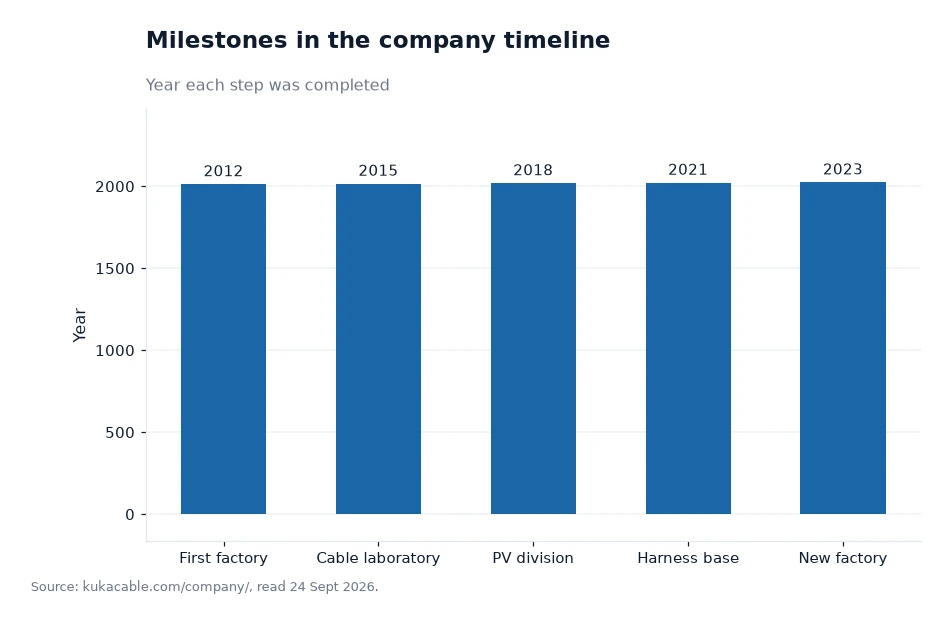
The dates explain where the three forces get measured. A speciality cable laboratory was established in December 2015 and is described as an ISO/IEC 17025 laboratory; the PV division became independent in August 2018; the harness processing base followed in June 2021 and a new factory in May 2023. Before 2015, the company was a cable maker without its own laboratory, which is the part of the timeline that matters when a buyer is weighing test evidence.
The site describes its SIF quality model as going beyond TUV certification, in four stages: raw materials tested against several international benchmarks, manufacturing monitored by digital control systems, 100% inspection of finished products for electrical, mechanical and environmental performance, and retained samples with traceability. Whichever force eventually retires a cable, traceability is what makes the failure diagnosable.
| Force | Published figure or test | What it protects |
|---|---|---|
| Weather — UV | 2,000-hour xenon lamp test, about 360 weathering cycles | Jacket integrity under sunlight, humidity and ozone |
| Weather — cold | Ambient range −40 °C to +90 °C; cold bending and cold elongation tests | Routing and re-work in winter conditions |
| Weather — water and abrasion | Water resistance test; cable abrasion test | Sheath wear on tiles, trays and racking |
| Current | Rated DC 1.8/1.8 kV; short circuit +120 °C (20,000 h), +250 °C (5 s) | Continuous duty and fault coordination |
| Chemistry — jacket | XLPO, electron-beam cross-linked, LSHF | Ageing resistance and smoke behaviour |
| Chemistry — conductor | Tinned copper, class 5 to IEC 60228; corrosion resistance test | Terminations and cut ends |
| Chemistry — fire | Vertical burn at 800 °C for one minute, self-extinguishing | Behaviour beside hot components |
Worked example
Compare the elongation figures to see how the margin is published. EN 50618 requires more than 125%, and the client states its PV cables typically run about 20% above that, reaching up to 185%. If 20% is applied to 125%, the result is 150%; the stated 185% is instead 48% above the requirement, which is 185 divided by 125. Those two figures are my own arithmetic on the published numbers, and they assume the 20% is a rough description rather than an exact multiplier.
Now apply the same habit to the weathering figure. A 2,000-hour exposure equated with about 360 cycles works out at 5.6 hours per cycle in my own division, which is a way of saying the cycles are accelerated rather than calendar-bound. A project with a 25-year horizon cannot replicate that on site, so the number to request from a supplier is the test report, not a service-life statement. The published service life is 25 years or more, and one product page states 30 years for the model it describes.
Frequently asked questions
Which of the three forces is the limiting one?
The site does not rank them, and it publishes no field-failure data. It does publish the individual limits: about 360 weathering cycles from the 2,000-hour xenon test, an ambient ceiling of +90 °C, a five-second short-circuit limit of +250 °C and an elongation of up to 185% against a 125% requirement, so a project can compare its own duty against each in turn.
Does the site publish a current rating per cross-section?
No. The pages read give the rated voltage as DC 1.8/1.8 kV, the conductor construction and the short-circuit temperatures, but publish no ampacity table, no bundling factor and no conduit derating, so current-carrying capacity has to be derived from the installation code that applies to the site.
How to use the three forces in a review
Turn each force into a document request. For weather, ask for the UV and cold-bending test reports and the measured elongation figure for the batch. For current, ask for the routine test record covering the spark test at 10 kV and the finished-cable test voltage of 6.5 kV AC for five minutes, then apply your own derating to the published cross-section. For chemistry, ask for the certificate copy that names the standard, since the range is described against TUV 2PfG 1169/08.2007, EN 50618:2014 and IEC 62930.
Three documents and one calculation cover most of the argument, and they are all traceable. The manufacturer publishes its solar cable range, the test list behind the laboratory work and the certificate collection on its own domain, so a buyer can read the same material before asking a supplier to confirm it.
Attribution: weather, current and chemistry figures above belong to the manufacturer's own website and were obtained 24 Sept 2026[1].