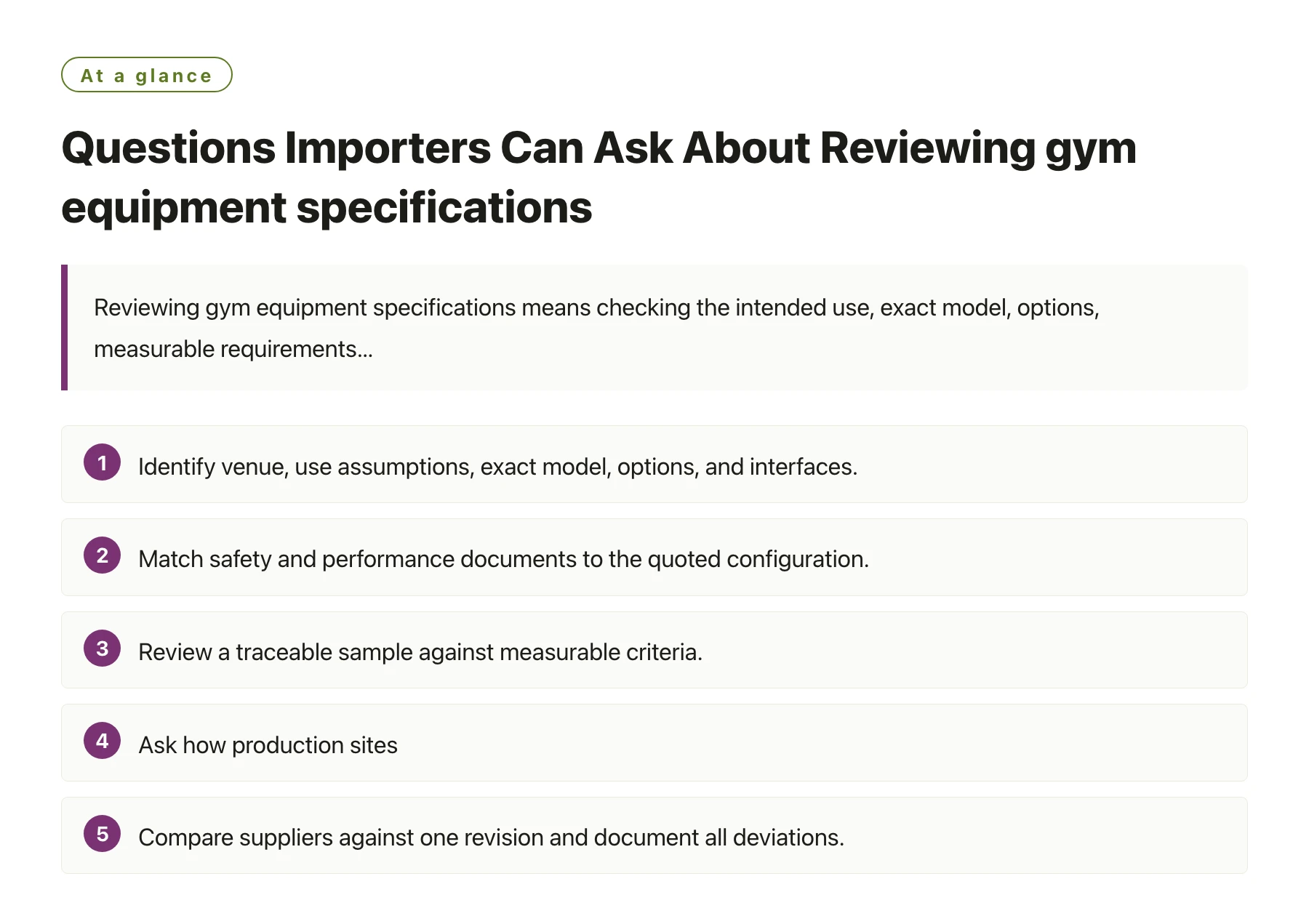
Reviewing gym equipment specifications means checking the intended use, exact model, options, measurable requirements, applicable evidence, sample configuration, supplier controls, and support plan. Importers should resolve open points and link every approval to the same product revision before placing an order.
Key takeaways
- Identify venue, use assumptions, exact model, options, and interfaces.
- Match safety and performance documents to the quoted configuration.
- Review a traceable sample against measurable criteria.
- Ask how production sites, subcontractors, capacity, and support are controlled.
- Compare suppliers against one revision and document all deviations.
Fitness equipment quotations can use similar product names while describing different configurations. These questions help importers find gaps before approving a supplier or sample.
Ask what the specification actually identifies
Does the document name the intended venue and equipment class? A treadmill for a home room, hotel gym, school, or supervised club can have different use assumptions. Ask who controls access, who maintains the unit, and whether the equipment is stationary, powered, or intended for a special user group. Let a qualified product owner determine which requirements apply.
Does each line identify the exact model and options? Record dimensions, adjustment ranges, resistance system, motor or console configuration, connection interfaces, accessories, power supply, and installation method. A family brochure may describe several variants; request a model-specific quotation and drawing so the buyer can compare the actual offer.
Do the requirements include measurable values? Replace phrases like robust, commercial grade, and smooth with dimensions, materials, load criteria, test method, or performance limits selected by the product owner. Where the requirement is not yet defined, mark it as an open technical question rather than asking suppliers to make unrelated assumptions.
Ask which safety and performance evidence applies
Which standards, market rules, and product-specific test methods are relevant? ISO 20957-1:2024 sets general safety requirements and test methods for indoor stationary training equipment, while other parts of the ISO 20957 series address equipment types. Ask a qualified reviewer to identify the applicable edition and product-specific parts for the exact equipment and destination.[1]
Does the evidence identify the same model, options, factory, and production configuration as the quote? Ask for the report or certificate type, issuer, date, standard and edition, test configuration, and limitations. A document for a similar model or one component may not cover the complete machine or the options in your order.
Which characteristics need testing rather than document review? For powered or load-bearing equipment, a simple visual sample may not assess electrical, mechanical, durability, or safety characteristics. Assign specialist testing to competent personnel and set the acceptance method before purchase release.
Ask how the sample will be compared
Is the sample stock, modified, or production-equivalent? Record product code, options, firmware, finish, date, and factory. Identify deviations from the quotation. If the supplier changes frame dimensions, upholstery, console, resistance components, or accessories after approval, require a written change request and decide whether a new review is necessary.
What will be checked and by whom? Create a checklist for identity, assembly, adjustment, operation, noise or vibration where relevant, labels, manuals, accessories, packaging, and finish. Specify conditions and acceptance criteria. A short demonstration can confirm selected functions but does not establish long-term reliability or regulatory compliance.
Will the approved sample remain traceable? Label it and save a dated approval record, measurements, photographs, and open issues. Keep the final record linked to the purchase order and product revision so production and incoming reviewers know which configuration governs.
Ask what production and support the supplier controls
Where are the equipment and its critical parts produced or assembled? Identify subcontracted processes such as welding, machining, upholstery, electronics, or coating. Ask how the supplier tracks revisions, incoming components, inspection records, nonconforming units, and approved substitutes across those sites.
Can the supplier meet the requested production window with the quoted options? Ask about current workload, long-lead components, test capacity, packaging readiness, and realistic milestone dates. Request early notification rules for a material delay or process change, not just an updated delivery promise at the end.
What happens after delivery? Confirm installation, commissioning, training, manuals, software, warranty, response route, spare parts, and maintenance. Ask for part numbers and service documentation that match the offered model. For international projects, confirm which support is remote and which depends on a local technician.
Ask how to compare suppliers on one basis
Send each bidder the same specification revision and require a line-by-line response: meets, deviates, not offered, or clarification needed. Compare product configuration, evidence, included accessories, packaging, sample status, lead time, warranty, spares, and commercial assumptions. Keep alternates in separate rows so they do not silently replace the requested model.
For Chinese manufacturers of gym equipment, buyers can request supplier research and coordination around model documentation, sample follow-up, or production communication. Define the support scope and leave technical acceptance and market compliance decisions with qualified buyer owners.
Before order release, resolve every critical deviation, approve the sample and required documents, and confirm that the quote, purchase order, drawing, and inspection plan share the same model and revision. Record who can approve later changes and what evidence must be updated.
Sources
Frequently asked questions
Does one general standard cover every kind of gym equipment?
Not necessarily. Identify the product type and destination, then have a qualified reviewer confirm the applicable general and equipment-specific requirements and editions.
Can a sample demonstration replace a test report?
No. A demonstration shows selected functions under observed conditions. Request model-specific evidence for characteristics that need defined or specialized testing.
What if a supplier changes a component after sample approval?
Require a written change request describing configuration, evidence, cost, and timing effects, then obtain approval and decide whether a revised sample or test is needed.
What support should be confirmed before ordering?
Confirm installation, commissioning, manuals, training, warranty, spare parts, software or console support, and the service route for the exact model.