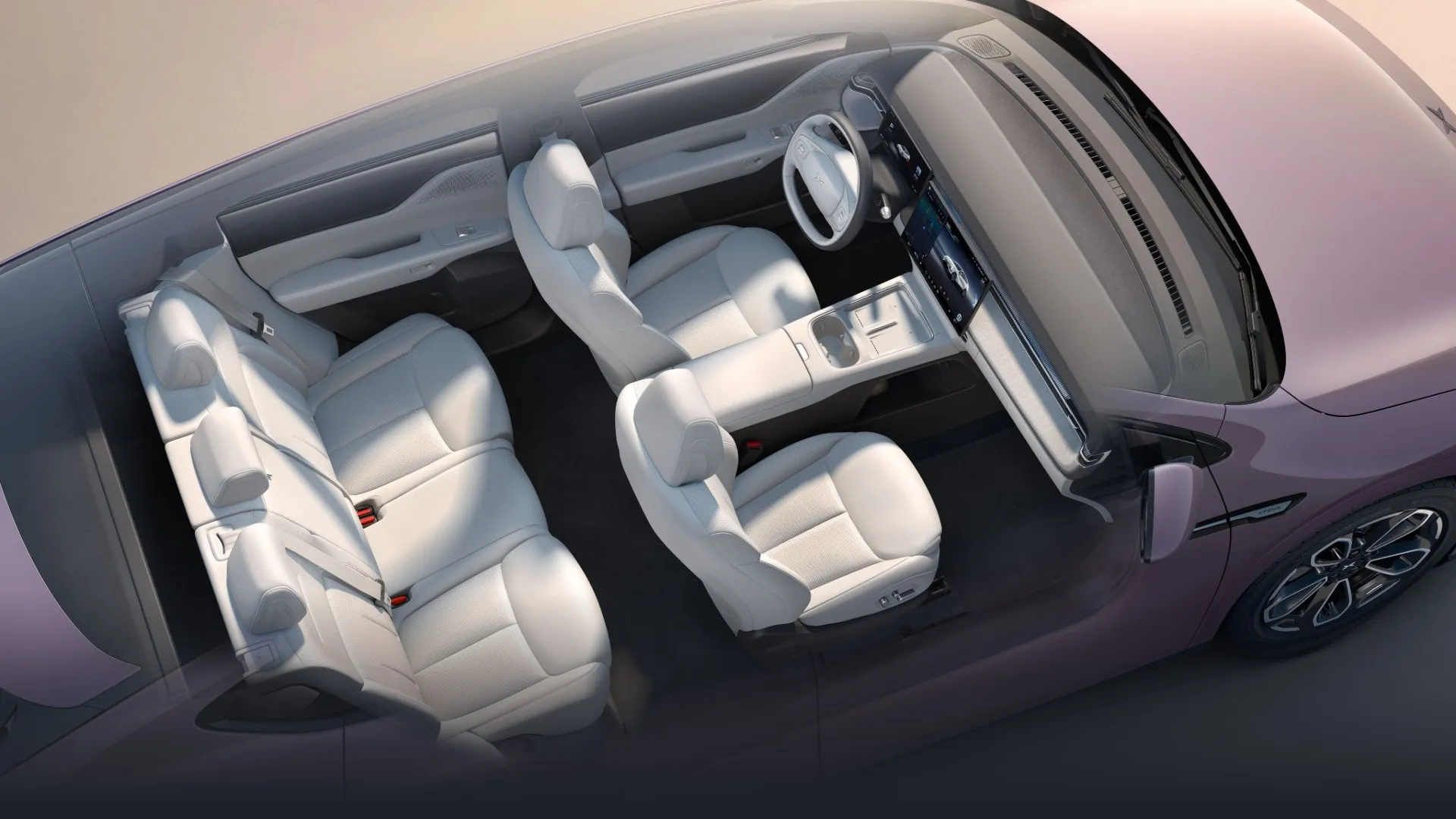
Yes. For Australian buyers who need one EV for commuting, family use and longer trips, the 2026 XPENG G6 has a strong practical case. Prices start at $51,800 before on-road costs, while the RWD Long Range costs $56,800 and offers up to 525 km of WLTP range. Its 80.8 kWh LFP battery can accept up to 451 kW DC charging, with XPENG quoting 10–80% in 12 minutes under suitable conditions. The G6 also provides 571 litres of boot space, a 2,890 mm wheelbase and a five-star 2024 ANCAP rating, although public charging access and local servicing still need checking before purchase.
The first figure worth looking at is price because the G6 sits in one of Australia’s busiest electric SUV brackets. For 2026, the RWD Standard Range is $51,800 before on-road costs, the RWD Long Range is $56,800, and the AWD Performance is $63,800; the Performance Black Edition reaches $66,800. The Standard Range was listed around $3,190 below the BYD Sealion 7 entry price and about $7,100 below the Tesla Model Y entry price when the updated G6 pricing was announced.
That price difference matters more when equipment is compared rather than simply looking at the badge. The 2026 G6 includes Nappa leather, heated, ventilated and massaging front seats, a panoramic glass roof, a 15.6-inch central display, a 10.25-inch instrument screen, wireless Apple CarPlay and Android Auto, and an 18-speaker audio system across much of the range. Buyers comparing electric cars australia options therefore do not need to add several comfort packages before reaching a well-equipped specification.
Battery capacity then separates the versions. The Standard Range uses a 68.5 kWh LFP battery with a 185 kW rear motor and 440 Nm of torque, while the Long Range moves to an 80.8 kWh LFP battery and 218 kW without changing the 440 Nm torque figure. In 2026 specification, WLTP range reaches about 480 km for the Standard Range and 525 km for the Long Range, depending on wheel configuration.
Those WLTP figures should not be read as guaranteed road-trip distances. A car rated at 525 km may cover less at sustained motorway speed because aerodynamic resistance rises sharply as speed increases, while air-conditioning, tyre pressure, elevation, passenger weight and outside temperature also affect consumption. A practical trip plan normally keeps a battery reserve rather than arriving at a charger with 0%, so a 10% buffer alone removes more than 50 km from the rated figure before other losses are counted.
A 525 km WLTP rating is most useful as a comparison figure. For a 2026 Australian owner, charger spacing and the distance travelled between roughly 10% and 80% state of charge matter more on a long highway journey.
Charging performance helps compensate for that reduced usable road-trip window. The refreshed G6 moves to an 800V electrical system with 5C charging technology; the Long Range and AWD Performance can accept up to 451 kW DC, while XPENG states that 10–80% can take about 12 minutes when battery temperature, charger output and other conditions are suitable. The company also quotes as much as 427 km of added range in 15 minutes for the Long Range.
A maximum of 451 kW should still be treated as a vehicle capability rather than a normal charging rate. A 150 kW public charger cannot supply the car at 451 kW, and even on a suitable high-output unit the charging curve does not remain at its peak from 10% to 80%. For owners who mostly use 7 kW home charging overnight, the G6’s extreme DC figure may rarely matter; for interstate users, it can shorten stops where newer high-power infrastructure is available.
The physical size also explains why the G6 can work as a household SUV rather than an enlarged hatchback. It measures 4,758 mm long, 1,920 mm wide and 1,650 mm high, with a 2,890 mm wheelbase. That wheelbase is roughly 61% of the car’s total length, leaving substantial cabin length between the axles and allowing useful rear legroom without stretching the body beyond typical medium-SUV dimensions.
| 2026 G6 measurement | Figure | Everyday relevance |
|---|---|---|
| Length | 4,758 mm | Manageable for a five-seat family SUV |
| Width | 1,920 mm | Spacious cabin, but worth testing in narrow parking bays |
| Wheelbase | 2,890 mm | More room between front and rear seating rows |
| Boot, seats raised | 571 L | Suitable for suitcases, shopping or a pram |
| Boot, seats folded | 1,374 L | Useful for larger recreational equipment |
| Front boot | 0 L | Charging cables must share rear storage space |
Cargo capacity deserves attention because many EV specifications focus heavily on acceleration and charging. The G6 provides 571 litres behind the second row and 1,374 litres with the rear seats folded, while XPENG documentation lists a 923 mm luggage-opening width and a 761 mm loading sill in some market specifications. There is no front luggage compartment, so households carrying a full boot plus charging equipment lose a storage option offered by several competing EVs.
Passenger comfort is helped by a flat EV platform and the long wheelbase, while the refreshed model adds features that matter during Australian summer use. Ventilated front seats can reduce dependence on very low cabin temperatures, and the heat-pump climate system manages cabin and battery temperature more efficiently than a basic resistance heater in cooler conditions. Overseas G6 documentation states that the thermal system can heat the cabin and battery from -20°C to +40°C in just over four minutes, although Australian owners should treat that as a manufacturer test condition rather than a normal local result.
Safety data provides a more independent measure. ANCAP gave the G6 a five-star rating under its 2024 assessment, applicable to Australian variants, with 88% for adult occupant protection, 86% for child occupant protection, 81% for vulnerable road-user protection and 80% for safety assist. Standard equipment includes autonomous emergency braking, lane-keeping functions, emergency lane keeping, speed assistance and a centre airbag between the front occupants.
The individual scores matter because a five-star badge alone does not show where a vehicle performed well or less strongly. The G6’s 86% child-occupant result is relevant for family buyers, while the 80% safety-assist result shows that the rating did not depend only on the passenger cell. ANCAP also lists car-to-car, pedestrian, junction, crossing, backover and head-on AEB functions in its 2024 assessment.
Performance varies sharply between versions, although even the least powerful model is quick enough for normal motorway merging. The Standard Range produces 185 kW and 440 Nm and is quoted at 6.94 seconds from 0–100 km/h; the Long Range produces 218 kW and reaches 100 km/h in about 6.7 seconds. Those figures put both rear-wheel-drive models comfortably inside the performance level most households need.
The AWD Performance changes the character of the car more substantially. Two motors produce a combined 358 kW and 660 Nm, cutting the claimed 0–100 km/h time to 4.13 seconds, while its WLTP range is still quoted at around 510 km. At $63,800 before on-road costs in 2026, buyers pay roughly 12.3% more than the $56,800 Long Range for all-wheel drive and much stronger acceleration rather than a longer official range.
• Standard Range suits buyers whose weekly kilometres are moderate and who can charge at home.
• Long Range adds 12.3 kWh of battery capacity over the 68.5 kWh Standard Range pack and provides the highest claimed WLTP distance.
• AWD Performance suits owners who want all-wheel traction and 4.13-second acceleration, although the extra output is unlikely to reduce commuting time in normal traffic.
The Long Range therefore has a particularly sensible specification for households covering mixed city and regional mileage. An 80.8 kWh battery, 525 km WLTP figure, 451 kW maximum DC input and 218 kW motor sit between the lower purchase price of the Standard Range and the higher output of the Performance model. Its $5,000 premium over the Standard Range equals about 9.7% of the Standard Range’s 2026 list price, before on-road costs.
Ownership support deserves equal attention because XPENG entered the Australian market much later than long-established brands. In July 2026, XPENG ANZ said its Australian operation was moving toward as many as 50 sales outlets nationally and aimed to place most customers within a 40-minute drive of a showroom. The same announcement confirmed a factory-backed seven-year, unlimited-kilometre vehicle warranty plus 24/7 roadside assistance.
Network expansion is useful, but regional buyers should check the actual authorised service location available to them rather than rely on a national target. XPENG Australia says owners can use authorised dealers for maintenance, remote diagnostics are available, and roadside assistance covers the majority of Australia. In 2026, that support structure is still younger than networks operated by brands with decades of Australian sales history.
Towing adds another use case, although specifications should be confirmed against the Australian vehicle and approved tow equipment before purchase. XPENG documentation for the G6 lists up to 1,500 kg braked towing capacity and a 75 kg tow-ball vertical load in applicable markets. A trailer can raise energy consumption substantially at highway speed, so a 525 km WLTP figure should never be used to estimate towing range without a larger charging margin.
For a household travelling 40 km per weekday, annual commuting alone works out to roughly 10,400 km across 52 weeks before weekend travel is added. Even if real-world use delivered only 80% of a 525 km WLTP figure, the resulting 420 km illustrates why most owners with home charging would not need to recharge every day. Apartment residents without a dedicated charger face a different ownership pattern because public charging price, location and queue time become part of weekly use.
The G6 therefore fits some Australian lifestyles better than others. A suburban owner with off-street charging can make fuller use of its range, 571-litre boot and 2026 warranty package, while a regional owner should first map service access and the fast chargers used on regular routes. Its 1,920 mm width also deserves a real parking test for buyers using older apartment garages or narrow inner-city bays, because centimetres matter more there than a 4.13-second acceleration figure.